
Wanlin Group AndroidSBC · Query Terminal Thermal Printer Board, WF-K1331
Query Terminal Thermal Printer Board, WF-K1331
WF-K1331 Query Terminal Thermal Printer Board guide to reference specifications, interfaces, firmware, integration and OEM/ODM requirements.
Technical Coverage
Use this resource for application guidance, product selection context, implementation details and related engineering considerations.
Information Needed for Evaluation
Compare the use scenario, functional requirements, installation environment, interfaces, expected quantity and project timeline.
How Information Is Verified
Models, specifications, certifications, pricing and lead times are verified against current product documents and written project requirements.
News and Trends
Query Terminal Thermal Printer Board, WF-K1331
TL;DR: Query Terminal Thermal Printer Board
AndroidSBC software desk: Android 15 baseline and staged OTA channel published for the WF-K family serving international market, United States. The WF-K1331 self-service query terminal Android motherboard spans the information display and query kiosk and eleven sister models in the WF-K series, all built on the A133 quad-core ARM Cortex-A53 1.6GHz SoC with the PowerVR GE8300 GPU, dual 1080p output, LVDS plus HDMI, and Android 11 firmware support. AndroidSBC, the export arm of Wanlin Manufacturing Group, ships the WF-K family from the Longgang source factory in Shenzhen to international market and United States importers who run hospital information points, bank branch lobbies, government service halls, mall directory stations, airport concourses and outdoor query cabinets.
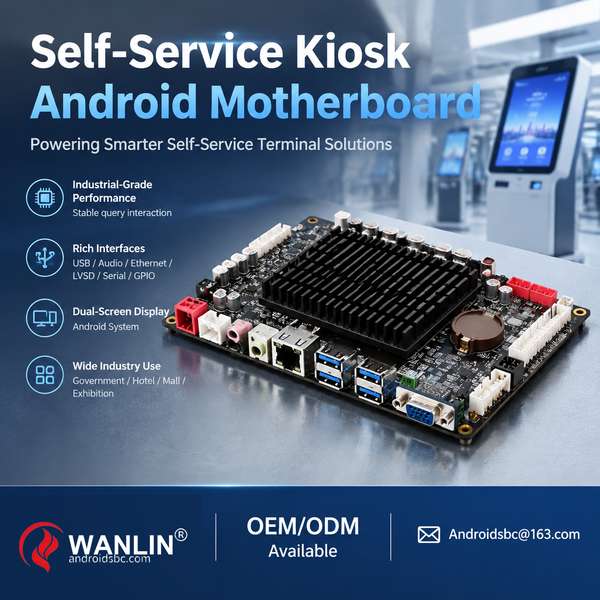
About AndroidSBC and the Self-Service Query Terminal Android Motherboard Family
Founded as a board house and now shipping to United States, Wanlin Manufacturing Group builds the WF-K self-service query terminal family in Longgang, Shenzhen. Twelve models share one firmware baseline and one peripheral interface contract, which keeps international market integrators from re-porting the touch, printer and card reader stack on every new project. The plant holds a standing allocation of LPDDR4X and eMMC for the WF-K line, which is how international market projects keep their lead times stable across quarters.
WF-K1331 Technical Specifications
| Parameter | AndroidSBC WF-K1331 (information display and query kiosk) | Industry Average |
|---|---|---|
| Processor | A133 quad-core ARM Cortex-A53 1.6GHz SoC | Older 28nm or 40nm quad-core SoC |
| Process node | 22nm | Older 28nm or 40nm process |
| GPU | PowerVR GE8300 | Older Mali-450 or basic GPU |
| NPU / AI | none | No NPU on competing entry boards |
| Memory | 2GB LPDDR4 | DDR3 1GB / 2GB on competing boards |
| Storage | 32GB eMMC | eMMC 5.0 8GB / 16GB on competing boards |
| Display output | dual 1080p output, LVDS plus HDMI | Single HDMI 1080p only on competing boards |
| Touch support | 10-point capacitive touch | Resistive single-touch on competing boards |
| Operating system | Android 11 | Android 8 or Android 9 on competing boards |
| Connectivity | WiFi 5 plus Bluetooth 5.0 plus Gigabit Ethernet | WiFi 4 plus 10/100M Ethernet on competing boards |
| Query peripherals | Capacitive touch, thermal printer, document scanner, card reader | No bundled touch, printer or scanner driver SDK on competing boards |
| Operating temperature | 0C to 50C | 0C to 40C on competing boards |
All parameters in the table above are measured at 25C ambient. The AndroidSBC WF-K1331 (information display and query kiosk) maintains its 4K HDMI output plus capacitive touch sampling while running the burn-in test loop, a configuration that competing single-platform boards cannot sustain at 60fps. For United States importers sourcing the WF-K family, the WF-K1331-A variant is the typical configuration for the train station information query rollout use case, with a sustained weekly capacity of 5000 pcs/wk.
Challenges in Sourcing Self-Service Query Terminal Android Motherboards for United States Buyers
Firmware forks are the quiet cost of query terminal projects in United States. When a international market integrator runs several chip tiers at once, every fork multiplies the validation effort across the estate.
The compliance route matters as much as the silicon. United States expects FCC Part 15 and FCC ID for radio modules, plus UL or ETL safety listing, and a query terminal board shipped to international market without that file set simply cannot be installed in a public building. AndroidSBC answers this with a single BOM per lot, so a international market order of 72700 units carries the same silicon and firmware as the pilot batch for United States.
Competitive Comparison: WF-K1331 vs Competing Self-Service Query Terminal Android Boards
Against the query boards usually quoted in United States, the WF-K board is positioned on integration completeness rather than on a single performance number for international market.
- Platform breadth: twelve models on eight chips (RK3588, RK3568, RK3566, RK3288, RK3399, A133, H618, T527), so {city} integrators can move between tiers without changing driver stack or mounting pattern.
- Bundled integration: touch, printer, scanner, card reader, camera and voice driver SDK ships in the carton; competing query boards sold to {city} usually ship a board only.
- Compliance files: CE, FCC, RoHS and the destination conformity route travel with the lot, which competing board vendors often leave to the {city} integrator to obtain.
- Long-term supply: one fixed BOM per production lot and a seven-year firmware window, against the frequent silicon swaps seen on competing query boards reaching {city}.
Global Self-Service Query Terminal / Information Kiosk Market Trends
Query terminals are becoming the default front door for routine information requests. In United States this is visible in tenders that bundle the information display and query kiosk with identity peripherals and printing, and international market integrators are quoting against those bundles rather than against bare boards.
- Volume shift to board-level sourcing: more integrators now buy the motherboard rather than the finished kiosk, which is why the WF-K1331 and WF-K3600 tiers ship in board form with the enclosure left to the local partner.
- Dual-screen becomes the default: hall display plus touch query on one board is replacing two separate devices, and the WF-K3600 and WF-K3601 configurations address that pattern directly.
- Longer service life expectations: operators now plan five to seven years per query terminal, which favours a fixed BOM such as the WF-K3601 over boards that re-spin silicon between lots.
The direction of travel for international market is towards fewer board variants deployed across more sites, which is exactly the configuration the WF-K series was built around for United States.
WF-K1331 Application Scenarios
The WF-K1331 information display and query kiosk sits inside a twelve-variant WF-K self-service query terminal Android motherboard family from AndroidSBC, a Wanlin Manufacturing Group export brand. The WF-K1331-A configuration is the typical build for the train station information query rollout use case, with touch panel and identity peripheral driver SDK plus staged OTA management bundled.
- Hospital and clinic information points: the WF-K1331 drives a touch query station at the entrance while the hall display shows the same information set to waiting visitors in international market.
- Bank and financial branch lobbies: touch query plus counter display from one board, with card reader and ID reader integrated for account and product lookups.
- Government service halls: the WF-K3602 runs tax, social security and real estate information lookup, with printing available on the same board.
- Shopping mall directories: the WF-K3566 serves mall directory and wayfinding lookup, with the advertising screen running an independent content loop.
- Airport and train station concourses: high-brightness information query where the WF-K3288 has to stay readable under strong ambient light.
- Retail and pharmacy price or product lookup: compact stations where the WF-K3399 fits a narrow counter without structural work.
- Outdoor and unheated information cabinets: the industrial tier holds the wide temperature window and 7x24 duty cycle for street-level query points.
- Multi-language public information points: on-screen lookup in more than one language from a single board, with voice assistance where the venue requires it.
- Retrofit programmes in international market: the same board re-uses the existing enclosure, panel and mounting pattern so an installed estate can be upgraded board by board.
Partnership Models for international market Buyers
AndroidSBC structures international market partnerships around how much integration the local partner keeps in house, with United States projects typically choosing between three levels.
- Distribution track: the partner buys the WF-K board against a published price list, keeps its own stock, and AndroidSBC supplies the driver SDK and compliance files with each lot.
- Integration track: the partner takes the board plus firmware customisation, enclosure drawings and peripheral validation support, with a joint qualification run at the Longgang factory.
- Private-label track: the WF-K board ships under the partner brand with customised boot logo, packaging and documentation, on a fixed BOM held for the length of the agreement.
For international market integrators the choice usually comes down to how much of the United States project the local team wants to own versus how much it wants the factory to carry.
Frequently Asked Questions
Does the WF-K self-service query terminal Android motherboard family support an information display and query kiosk?
Answer: Yes. The information display and query kiosk is covered by the standard WF-K driver SDK, which means the international market integrator configures it rather than ports it.
What is the real difference between the A133 tier and the other silicon tiers in the WF-K family?
Answer: Practically, the A133 tier is chosen when the United States use case matches its video and AI envelope. The interface contract is identical across the family, so the decision is about workload rather than about connectors or drivers.
Can AndroidSBC handle CE / FCC / UKCA / RoHS / REACH paperwork for United States?
Answer: Yes, and the paperwork is treated as part of the product rather than an add-on. For United States orders the CE, FCC, RoHS and REACH set is prepared alongside the production lot bound for international market.
What are the MOQ and lead time for a first order of the WF-K self-service query terminal family?
Answer: MOQ is quoted per model rather than per family, so a international market integrator can pilot one tier for United States without buying across all twelve. Samples take 1-3 days and bulk lots 15-30 days.
Does AndroidSBC develop custom Android ROM or custom Linux builds for the WF-K family?
Answer: Yes. AndroidSBC handles AOSP customisation, kiosk-mode lockdown and Linux images for the WF-K family, with the resulting build validated on the same rig used for United States shipments to international market.
How are software updates and long-term support handled on the WF-K family?
Answer: AndroidSBC maintains a seven-year firmware window on the WF-K family, with staged OTA and rollback. international market partners can freeze a revision per United States project and update on their own schedule.
Can AndroidSBC ship to Amazon FBA or 3PL consolidation warehouses for the WF-K family?
Answer: Yes, and where a international market seller runs its own 3PL arrangement in United States, AndroidSBC ships to that warehouse on the same terms as a direct buyer order.
How are RMA and DOA replacements handled on the WF-K self-service query terminal family?
Answer: AndroidSBC handles RMA and DOA replacements per production lot, which means a international market partner can trace a failure back to a specific build shipped to United States rather than dealing with an anonymous board.
Contact AndroidSBC: Start Your WF-K1331 Sourcing Conversation
international market integrators can reach the AndroidSBC export desk for the WF-K self-service query terminal family through the following channels:
- Email: Androidsbc@163.com
- Export service hotline: +8613261677119
- Website: https://www.androidsbc.com
- Source factory address: Wanlin Group, Building B, Building 1, Beisida Medical Device Building, 28 Nantong Avenue, Baolong Community, Baolong Sub-district, Longgang District, Shenzhen, Guangdong, China
A 1-3 day sample lead applies to United States buyers, a 15-30 day mass-production lead to bulk orders, and a seven-year firmware update window to the WF-K family.
News and Trends
- China Payment Terminal Board Manufacturer, WF-SPT-12
- Checkout Payment Terminal Board, WF-SPT-01
- SPI Interface Payment Terminal Board, WF-SPT-02
- Encrypted Payment Terminal Board, WF-SPT-03
- Hardware Encryption Payment Terminal Board, WF-SPT-04
- IR Touch Payment Terminal Board, WF-SPT-05
- 2GB+16GB Payment Terminal Combo, WF-SPT-06
- Allwinner A133 Payment Terminal Android Board, WF-SPT-08
- China Handheld POS Board Manufacturer, WF-POSH-08
- Android Mobile Payment Board, WF-POSH-01